


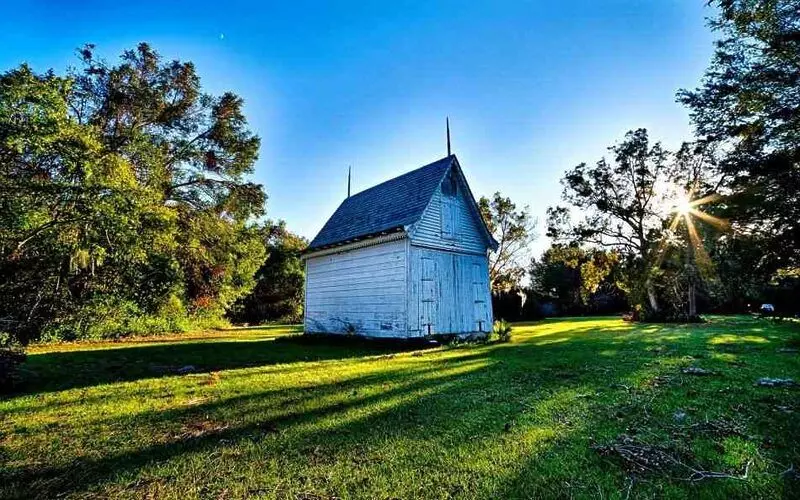
Edisto Island churches are some of the oldest buildings you can see on the island, and most of them line SC Hwy 174, the road you drive to reach the beach. The white Presbyterian church, Trinity Episcopal’s shingled steeple and the 1818 Baptist church with its slave gallery tell the story of the island’s planters, the enslaved people whose labor built their wealth, and the Black congregations that took shape after emancipation.
They’re also working churches, not museums. This guide covers the history and architecture of each one, where to find it and how to visit respectfully. If you’re looking for a place to worship during your stay, see the service times on EdistoBeach.com.
Edisto Island Churches at a Glance
- Location: Mostly along SC Hwy 174 in the middle of the island; Allen AME is on Botany Bay Road
- Cost: Free to view from the grounds
- Interiors: Generally not open for tours unless a congregation invites visitors; attending a service is the surest way to see inside
- Good for: History, architecture, old churchyards, a quiet stop on the drive in
- Time needed: An hour or two to see the Hwy 174 churches from outside
- Tips: Avoid service times, stay on paths and never park across a driveway on Hwy 174
Edisto Island Presbyterian Church
The Presbyterian congregation is one of the oldest in South Carolina. The South Carolina Encyclopedia and the church’s National Register nomination place its organization at about 1710, and some histories trace its roots to the 1680s. The current sanctuary on SC Hwy 174 was completed in 1831 and has been in use ever since.
The National Register record credits the design to a builder named Pillans and to E. M. Curtis of Charleston. The church was documented by the Historic American Buildings Survey, and the grounds include a Session House. The church was listed on the National Register of Historic Places on June 24, 1971, and the nearby Presbyterian Manse was listed separately the same year. The congregation belongs to the Presbyterian Church (USA).
Look for the Session House and the old churchyard. Park only in the church lot and stay out of the way of any services or events.
Trinity Episcopal Church
Trinity Episcopal Church stands at 1589 SC Hwy 174, according to the National Register listing. The parish was organized in 1774, and the National Register dates the present building to 1876. It replaced an earlier church that burned accidentally.
Architecturally, Trinity is the island’s odd one out. It’s a one-story wooden church in the traditional meeting-house shape, but built in Late Victorian style, with an inset steeple covered in white shingles. The National Register nomination describes it as Edisto’s only Episcopal church and its only example of Victorian church architecture. It was listed on the National Register on May 14, 1971.
Edisto Island Baptist Church (1818)
The Edisto Island Baptist Church at 1644 SC Hwy 174 may be the most historically layered building on the island. It was built in 1818, largely through the efforts of Hephzibah Jenkins Townsend, who had converted to the Baptist faith in 1807 and in 1811 founded the Wadmalaw and Edisto Female Mite Society to raise money for missions.
The 1818 core survives, including the gallery where enslaved members sat. Around 1865 an addition roughly doubled the building’s size, and in 1880 a two-story pedimented portico was added to the front. The walls are covered in beaded weatherboard and stand on a tabby foundation, the local building material made from oyster shell, lime and sand.
After the Civil War, the church’s trustees turned the building over to its Black members, and it has been a Black congregation ever since. Townsend died in 1847 and is buried in the churchyard; she is its only white burial. Her quilts are in the Smithsonian’s collection. On Sept. 23, 2025, Edisto Island’s first official state historical marker was unveiled at the church in her honor. The church was listed on the National Register of Historic Places on April 1, 1982.
Allen AME Church
Allen A.M.E. Church is on Botany Bay Road (8060 Botany Bay Rd, per the Edisto Chamber), the dirt road that leads to the Botany Bay preserve. You’ll pass it on your way to the tunnel of trees. It isn’t on the National Register, but it’s a familiar landmark for anyone heading to Botany Bay, and it has an active congregation. The Chamber lists its phone as 843-869-3715.
Because it sits right on a busy sightseeing route, Allen AME sees a lot of passing cars and cameras. Take photos from the road, don’t use the church lot as a pull-off, and slow down when services are letting out.
The Island’s Black Congregations
Enslaved Africans and their descendants, the ancestors of today’s Gullah Geechee community, did the work that made Edisto’s plantations rich. After emancipation, Black congregations became central to community life on the island, as they did across the Sea Islands.
The congregation that took over the 1818 Baptist church is one example. Detailed published histories for many island churches are hard to find, so the best sources are the congregations themselves and the Edisto Island Museum, whose permanent exhibit tells the Gullah story. Read more in our guides to Gullah culture and our Gullah Geechee articles.
How the Churches Fit Edisto’s Story
Edisto doesn’t have a single National Register historic district. Instead, the island’s churches, plantation houses and other sites were listed one by one through the Edisto Island Multiple Resource Area, a group nomination covering historic properties across the island. That’s why the churches above each have their own listing dates.
They also sit along the Edisto Island National Scenic Byway, the 17-mile stretch of SC Hwy 174 designated in 2009. Driving the byway with the churches in mind is a good way to read the island: congregations founded in the colonial era, buildings paid for by Sea Island cotton, and churches that passed to freed people after the Civil War. For more background, browse our Edisto history articles.
Visiting Etiquette
Every church on this page has an active congregation, and the island is a small community. A few simple courtesies go a long way:
- Avoid service times. Sunday mornings and funerals are not the time for sightseeing.
- Stay outside unless invited. Sanctuaries are generally not open for tours. If you want to see inside, attend a service.
- Treat churchyards gently. Stay on paths, don’t lean on or touch fragile old stones, and never make gravestone rubbings.
- Park properly. Use the church lot when it’s empty, or a safe shoulder. Never block driveways or church entrances on Hwy 174.
- Respect private land. Many old cemeteries and plantation sites on Edisto are on private property. View them from the road only.
- Keep it quiet. Even on a weekday, someone may be visiting a grave.
Old Sheldon Church: A Day-Trip Ruin
If historic churches are your thing, the Old Sheldon Church Ruins in Beaufort County, about an hour and a half from Edisto Beach, make a striking side trip. The Georgian temple-form church was built in the mid-1700s and burned twice, in 1779 and 1865. Details are on our ACE Basin page.
Edisto Island Churches FAQ
What is the oldest church on Edisto Island?
The Edisto Island Presbyterian congregation, organized by about 1710, is the oldest congregation covered here. Of the church buildings on this page, the 1818 Edisto Island Baptist Church is the oldest; the Presbyterian sanctuary dates to 1831.
Can I go inside the historic churches?
Usually not as a sightseer. The interiors are generally open only for services and church events, and attending a service is the respectful way to see inside.
Can I visit the church cemeteries?
Some churchyards can be viewed from paths when no service or burial is under way. Be respectful, don’t touch fragile stones and don’t make rubbings. Many other island cemeteries are on private land.
Where can I find church service times on Edisto?
Use the EdistoBeach.com service-times link near the top of this page, and confirm with the congregation, since schedules change.
Is there an Edisto Island historic district?
No. Edisto’s historic properties were listed individually through the Edisto Island Multiple Resource Area rather than as a single historic district.
Plan Your Trip
Pair a churches drive with the Edisto Island Museum, our roundup of Edisto Island attractions and historic sites, or the story of the lost village of Edingsville, then find more ideas in our things to do guide.